Ecommerce Development
Shopify · Medusa.js · Payload CMS
Headless Ecommerce Development
For companies that need the right ecommerce setup for growth, operations, and content.
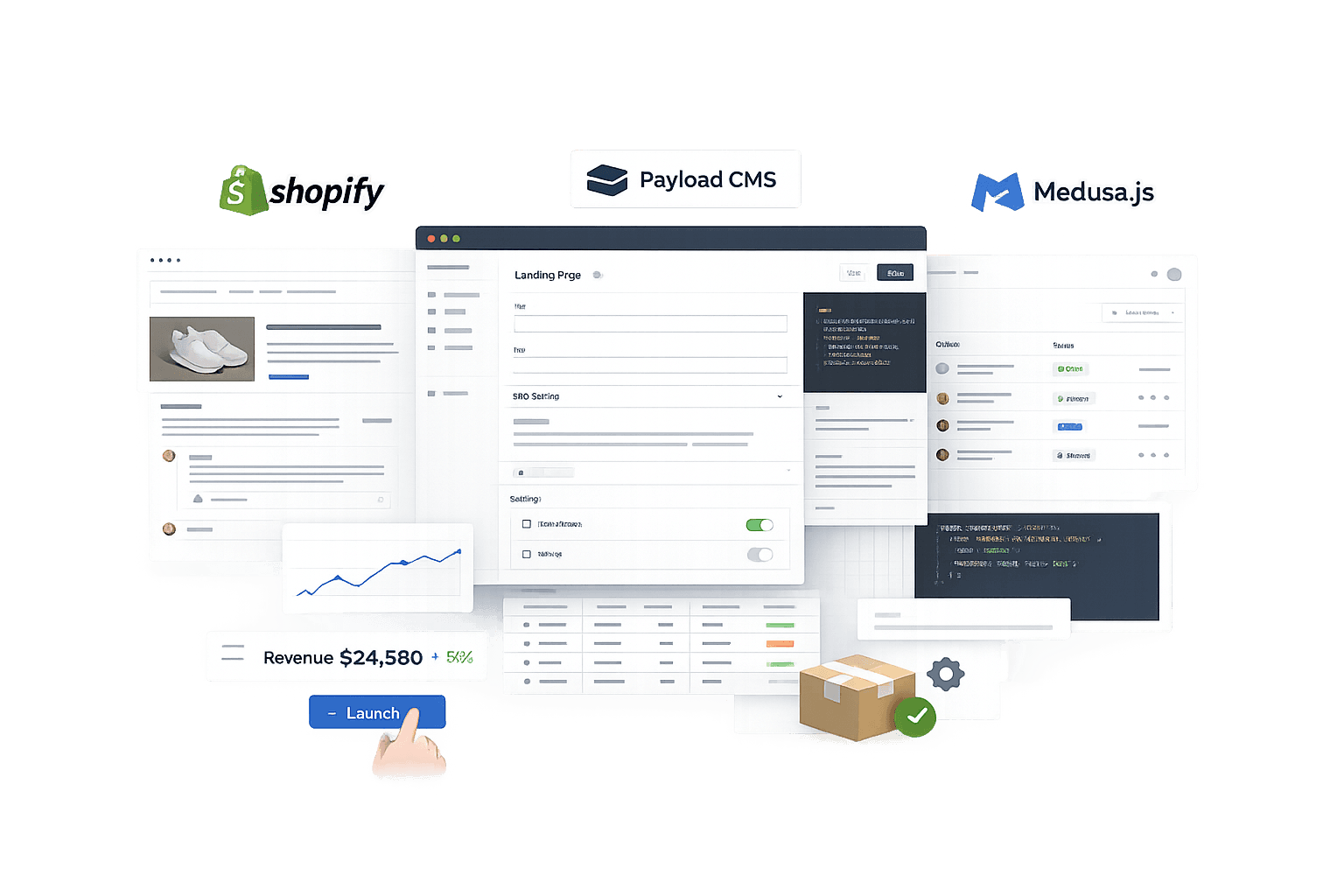
Most Ecommerce Projects Go Wrong Before the Build Starts
The business chooses a platform that looks flexible but becomes expensive to operate. Or it stays on a setup that is easy to manage but starts limiting content, customer experience, integrations, or growth.
I help companies make the right ecommerce architecture decision before those costs compound, then build the system properly.
Whether you need a polished Shopify storefront, a more tailored Medusa.js setup, or a custom commerce and content system in Payload CMS, the goal is the same: a system that fits how your business actually sells.
Who This Is For
This is not for every ecommerce project. It is for companies where the platform decision has real business consequences.
Your current ecommerce setup is starting to limit growth
The platform made sense at the start. Now the constraints are showing up in the product catalogue, the checkout flow, the content around the store, or the integrations that don’t quite work. The cost of staying is compounding.
You need better coordination between content, commerce, and operations
Your storefront, your editorial content, and your operational workflows are three separate things that should work together. When they don’t, every new requirement requires coordination across systems that weren’t designed to talk to each other.
You’re unsure whether Shopify is enough, or whether a more tailored setup is justified
This is the right question to be asking before the build, not after. The answer depends on your catalogue, your team, your content needs, and how the business actually sells — not on what the platform demo looks like.
You want direct senior involvement in both the decision and the implementation
You’re not looking for an agency handoff. You want someone who will stay involved from the platform decision through delivery — and who will tell you clearly when the simpler option is the right one.
What the Engagement Covers
I help companies with ecommerce projects where the platform decision matters. This is not a generic agency handoff. I stay involved from the decision stage through delivery.
Platform Evaluation & Architecture
Working through the platform decision before a rebuild or migration starts. Evaluating Shopify, Medusa.js, and Payload CMS against your specific catalogue, team, workflow, content, and integration requirements. Defining the right system shape before any implementation begins.
Frontend & Backend Implementation
Building the storefront, the commerce logic, and the integrations. Next.js frontend development, Shopify storefront customization, Medusa.js backend configuration, and Payload CMS commerce and content systems. End-to-end implementation without handoffs.
Content & Commerce Integration
Connecting editorial content, product data, and operational workflows in a system that actually holds together. Rollout planning, launch stabilization, and the post-launch work that keeps the system running as the business evolves.
This is principal-led work. I don’t subcontract the architecture decisions or the implementation. You work directly with the person who designs and builds the system.
Choose the Right Setup for the Business
I do not push one stack by default. The right choice depends on your catalogue, team, workflows, content needs, and long-term priorities.
Shopify
Best when speed, reliability, and operational simplicity matter most.
Shopify is often the right choice for brands that need a strong ecommerce foundation, a mature ecosystem, and a storefront that can be launched and managed without unnecessary complexity. If the business needs to move quickly and the operational overhead of a more tailored system isn’t justified, Shopify is the right call.
Medusa.js
Best when the business needs more tailored commerce logic and backend flexibility.
Medusa.js is a stronger fit when standard platform constraints start getting in the way and the business needs more control over how products, orders, or workflows are handled. It requires more implementation investment, but gives you the flexibility to build commerce logic that matches how the business actually operates.
Planning a Medusa implementation? See Medusa.js development services →
Payload CMS
Best when content and commerce need to work closely together in one tailored system.
Payload CMS can be a strong fit when the project is not just about selling products, but also about managing structured content, editorial workflows, and a more custom digital experience around commerce. It works well when the content layer is as important as the transaction layer.
When Headless Ecommerce Actually Makes Sense
Headless ecommerce makes sense when the business needs more flexibility than a standard storefront can offer.
That might mean a better content experience, more control over frontend performance, tighter integration with internal systems, or a customer journey that does not fit neatly into a template.
But headless only makes sense when the added flexibility is worth the additional complexity. That is the point of the engagement: to help you avoid both extremes. Not overbuilding when Shopify is enough, and not underspecifying the system when the business needs more.
Selected Ecommerce Work
Shopify
Alexandra Maxa
Shopify ecommerce for a premium product brand
Alexandra Maxa needed an ecommerce experience that matched the quality and personality of the products. The focus was not simply getting a store live, but creating a storefront that supported premium brand presentation, clear product merchandising, and a smoother buying journey.
View project →Custom Commerce
Kmetija Mehak
Custom ecommerce and ordering flow for a producer business
Kmetija Mehak needed more than a standard online store. The business required a system that supported product presentation, trust-building content, and a tailored ordering flow shaped around how customers actually buy from the farm.
View project →How the Engagement Works
I work directly with a small number of clients at a time. You are not buying layers of account management or a team structure built to maximize handoffs. You are getting senior involvement in the decisions that shape the project.
Define what the business actually needs
Before any platform decision, we map out what the business requires: catalogue structure, content needs, operational workflows, integration requirements, and long-term ownership constraints. This defines the decision criteria.
Choose the right platform and system shape
With clear requirements, the platform decision is straightforward. I give you a direct recommendation with the reasoning, not a shortlist that leaves the hard call to you.
Build with clarity and discipline
Implementation proceeds with a defined scope and clear milestones. I stay involved in the decisions that shape the system throughout the build, not just at the start.
Launch and stabilize properly
Launch is not the end of the engagement. The period after go-live is when the system meets real usage. I stay involved through stabilization so problems get resolved before they compound.
You Need Implementation Help and Judgement
The hardest part is often not building the store. It is knowing whether to keep things simple, where to customize, and when a more tailored setup is actually justified.
I bring both sides of that decision together: clear technical judgement and practical implementation.
A solution matched to the business
Direct senior involvement
No unnecessary complexity
A build designed to hold up beyond launch
FAQ
Frequently Asked Questions
Do you only build headless ecommerce projects?
How do you decide between Shopify, Medusa.js, and Payload CMS?
Can you help if we are still evaluating platforms?
Do you handle both strategy and build?
Is this a fit for smaller ecommerce businesses?
Choosing the Wrong Ecommerce Setup Is Expensive.
If you are deciding between Shopify, Medusa.js, or a more tailored content-commerce system, I can help you make the right call and build it properly.
Still choosing a platform
Start with a commerce architecture review before you commit to an implementation path.
Start with a commerce architecture reviewAlready evaluating Medusa
Discuss a Medusa.js implementation with clear ownership across backend, storefront, and content.
Discuss a Medusa.js implementationPrincipal-led. Direct involvement from decision through delivery.