Medusa.js development for custom B2B commerce.
I design and build Medusa.js commerce platforms for companies that need custom pricing, ordering workflows, storefronts, integrations, and greater ownership of their commerce infrastructure.
The engagement can cover the architecture, Medusa backend, Next.js storefront, Payload content layer, migration, infrastructure, and launch.
Principal-led architecture and implementation. Direct involvement from platform decision through production launch.
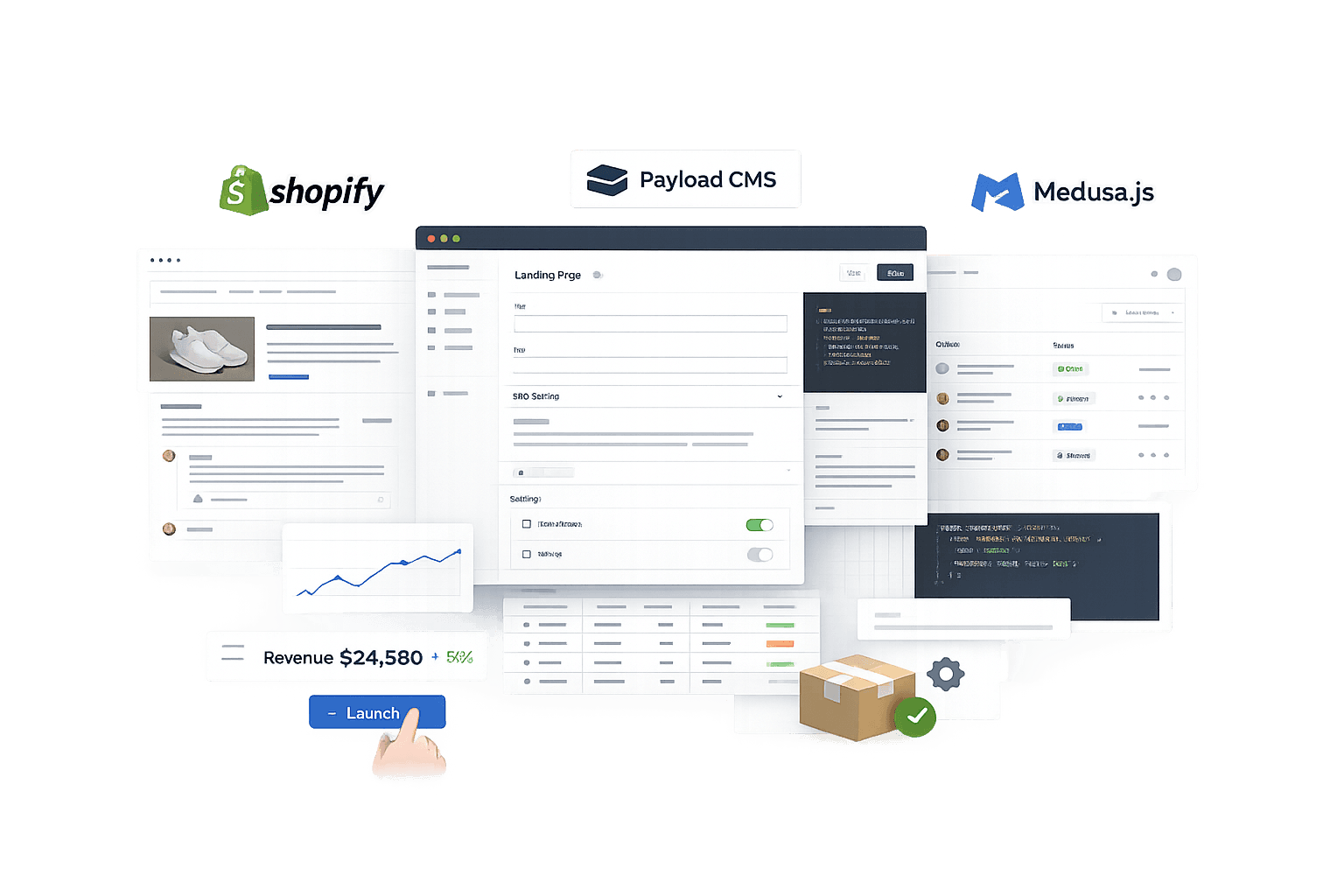
Commerce requirements eventually outgrow standard platform assumptions.
Standard commerce platforms work well when the buying journey, catalog, pricing, and operations fit the platform model. Medusa becomes relevant when the business needs commerce logic shaped around its own operational requirements.
The work starts from the constraints: customer-specific pricing, dealer accounts, quote flows, ERP connections, multi-market rules, or a migration that has to preserve SEO and operational continuity.
Medusa is the technical foundation when custom commerce requirements justify owning the backend, data model, workflows, and hosting — not when a managed platform already fits.
Fit
When Medusa is a strong fit
These are the situations where a custom commerce foundation usually beats stretching a standard platform.
B2B pricing
Different prices, catalogs, terms, or discounts by customer.
Dealer and distributor commerce
Company accounts, permissions, locations, and purchasing roles.
Complex product structure
Variants, bundles, configurable products, or external product data.
Custom order flow
Quotes, approvals, staged checkout, deposits, or offline processing.
Operational integration
ERP, PIM, CRM, tax, fulfillment, payment, and warehouse systems.
Multi-market commerce
Regions, currencies, channels, localized storefronts, and market rules.
Platform migration
Replacing WooCommerce, Shopify, or legacy commerce infrastructure.
Platform ownership
Greater control over the backend, data model, workflows, and hosting.
Architecture
Clear ownership across commerce, content, and presentation
The strongest Medusa implementations keep system boundaries explicit so each layer owns what it is best at.
| System | Responsibility |
|---|---|
| Medusa | Products, handles, variants, prices, inventory, customers, carts, orders, fulfillment, promotions, and commerce workflows |
| Payload CMS | Content, reusable product-page templates, editorial workflows, media, structured pages, localization, and preview |
| Next.js | Product routes, storefront components, data composition, caching, rendering, and customer interactions |
| External systems | ERP, PIM, CRM, payment, tax, shipping, analytics, and search |
Zero-duplication product pages
- 01Medusa product handle
- 02Next.js /products/[handle]
- 03Medusa supplies live commerce data; Payload supplies the shared product-page template
- 04Next.js renders the complete page
Payload does not require a duplicate product document for every Medusa product when the catalog follows a shared template. Medusa owns product data and supported handles. Next.js reserves and renders the product route. Payload controls approved page sections, presentation variants, reusable content, and draft preview through a Global.
Scope of Work
What a Medusa engagement covers
Every engagement is scoped to the commerce constraints that matter. These are the capability areas that typically appear after the architecture is clear.
Architecture and platform evaluation
Commerce domain mapping, platform suitability, system boundaries, data ownership, infrastructure model, implementation roadmap, migration planning, and risk identification.
Medusa backend development
Modules and data models, workflows, API routes, events and subscribers, pricing, promotions, regions and sales channels, customers and company accounts, orders and fulfillment, and admin extensions.
Next.js storefront development
Catalog and search, product routes, product detail pages, cart and checkout, account areas, B2B purchasing flows, localization, caching and revalidation, SEO and structured data, performance and accessibility.
Payload CMS integration
Product-page template Globals, editorial landing pages, reusable campaign content, media, localization, draft preview, editorial roles, and content workflows.
Integrations
ERP, PIM, CRM, payments, tax, shipping and fulfillment, search, analytics, email and automation, and existing internal APIs.
Migration and production launch
Catalog migration, customer and order handling, URL mapping and redirects, SEO preservation, infrastructure, database deployment, Redis and workers, object storage, monitoring, and launch stabilization.
Judgement
Medusa should solve a real commerce constraint.
An architecture review may recommend remaining on Shopify, using Payload Commerce, or improving the current platform. The goal is the right commerce foundation — not Medusa by default.
| Platform | Strongest fit |
|---|---|
| Shopify | Standard commerce, fast launch, mature app ecosystem, low operational burden |
| Medusa | Custom commerce logic, backend ownership, integrations, B2B workflows, and tailored operations |
| Payload Commerce | Content-led commerce where the CMS and editorial system remain the center |
| Vendure | GraphQL-led commerce teams and projects where its architecture or enterprise features fit better |
| Existing platform | Businesses whose current system can meet requirements through targeted improvement |
How to engage
Three paths depending on where the decision and implementation stand.
Commerce architecture review
For teams evaluating platforms or validating an existing plan. Deliverable: recommendation, ownership map, risks, architecture, and implementation path.
Learn moreMedusa implementation
For companies ready to build. Deliverable: backend, storefront, integrations, infrastructure, and launch.
Learn moreMigration or system rescue
For companies replacing a platform or correcting an existing build. Deliverable: audit, migration plan, remediation, implementation, and stabilization.
Learn moreArchitecture and implementation research based on working systems
This is research and implementation material from working Medusa systems — not a finished client case study.
- Complete Medusa and Next.js integration guide
- Payload vs Medusa: presentation vs process
- Medusa vs Vendure research
- WooCommerce to Medusa migration planning
- Medusa pricing and hosting analysis
- Extend Medusa modules without editing core
- Share Medusa types across a Next.js monorepo
- Medusa architecture explained
Delivery
Principal-led delivery process
Define commerce requirements
Catalog, pricing, customers, checkout, fulfillment, integrations, content, and operating model.
Confirm the architecture
Platform recommendation, ownership boundaries, migration approach, and infrastructure.
Build in milestones
Medusa backend, Next.js storefront, Payload layer, integrations, and data migration.
Validate and launch
Testing, operational validation, SEO checks, monitoring, rollout, and stabilization.
Investment
What to expect on cost
These are minimum engagement floors so you can gauge fit before reaching out. Complex B2B platforms are scoped after discovery.
| Engagement Type | Starting Point |
|---|---|
| Commerce architecture review | From €2,000 |
| Medusa implementation | From €20,000 |
| Complex B2B commerce platform | Scoped after discovery |
FAQ
Frequently Asked Questions
Is Medusa a replacement for Shopify?
Can Medusa and Payload CMS work together?
Does Payload need to store Medusa products?
Can you migrate WooCommerce or Shopify to Medusa?
Do you work with an existing Medusa codebase?
Do we need separate Medusa and Payload admin panels?
Can you help us decide between Medusa and Vendure?
Build the commerce system around the way the business actually sells.
Share the current platform, the commerce constraints, and the systems that need to connect. I will help determine whether Medusa is the right foundation and define the implementation path.